
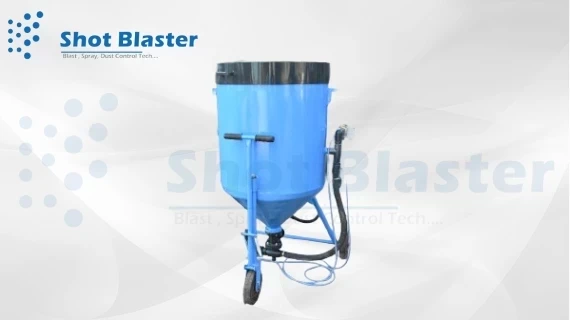
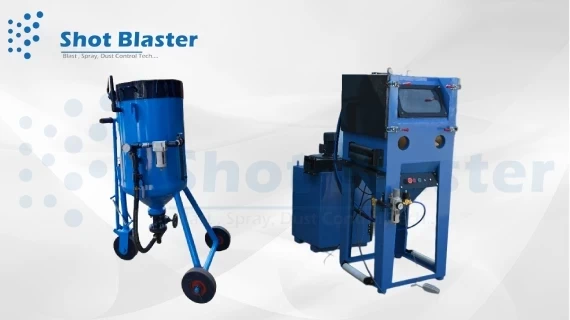
Shot Blasting Machine in United States
| Product | Shot Blasting Machine |
| Material | Mild Steel |
| Machine Type | Portable and Cabinet |
| Grade | Manual, Semi-Automatic, and Automatic |
| Abrasive Tank Capacity | 150–1000 Kg |
| Nozzle Type | Tungsten/Boron/Silicon Carbide |
| Blasting Nozzle Size | 5-10 MM |
| Blast Hose Length | 5-12 Mtr |
| Compressed air (80 psi) | 17-217 Cfm |
| Cleaning Rate | 3-21 sqr. mtr/ hr |
| Motor Power | 220 V |
| Frequency | 50Hz |
| Brand | Shot Blaster |
| Color | As per client requirement |
| Delivery Time | 1-2 Weeks |
| Packaging Details | Polly Pack With Bubble Packing |
| Transport Type | Land/Sea/Air Transport |
Introduction of Shot Blasting Machine in United States
Shot blasting machine is a powerful cleaning and surface‑preparation machine widely used in the United States steel, automotive, shipbuilding, and construction industries. Whether you’re removing rust from bridge parts, stripping paint off ship hulls, or preparing automotive castings, a shot blasting machine in United States delivers fast, uniform results.
At its core, a shot blasting machine in United States involves firing small steel shots called abrasive media at high speed onto a workpiece. This impact scrubs away contaminants like old paint, rust, welding scale, or sand, and leaves behind a slightly rough texture that helps new coatings adhere firmly. A well‑maintained shot blasting line boosts productivity, cuts labor costs, and improves product quality.
Six Main Subsystems of a Shot Blasting Machine
Every industrial shot blasting installation breaks down into six core areas:
- Abrasive Delivery
- Media Recovery & Cleaning
- Dust Collection
- Blast Cabinet
- Work Handling
- Controls & Instrumentation
Each subsystem works together to keep machines running safely, efficiently, and with minimal waste.
Abrasive Delivery: Accelerate and direct abrasive particles onto the workpiece at controlled speed and volume.
Two main methods:
- Compressed Air (Pneumatic)
- Centrifugal Turbines (Wheel Blast)
Media Recovery & Cleaning: Gather spent media, remove dust and broken fragments, and return clean shot or grit to the blast system.
- Collection hopper: Abrasives and debris drop through the floor of the cabinet.
- Vibratory / Screw conveyors: Move mixed media to an elevator.
- Bucket elevator: Lifts media to a separator up top.
- Air‑wash or mechanical separator: Strainers, baffles, and airflow strip dust and fines from reusable shot.
- Feed hopper: Gravity feeds cleaned media back to the turbines or nozzles.
A well‑sized recovery system prevents worn media from over‑abrasion, reduces dust in the air, and saves on media costs.
Dust Collection: Capture airborne dust to protect operators and maintain a clean plant. Common designs:
- Baffle‑style filters: Heavy plates catch large dust flakes.
- Cartridge filters: Remove fine particulates down to a few microns.
- Pulse‑jet cleaning: Periodically blows compressed air through cartridges to shake off dust.
A strong dust collector maintains slight negative pressure inside the cabinet, ensuring no dust leaks out. Proper sizing based on cabinet volume and blast airflow is critical. Too little suction and dust piles up; too much and the blast pattern weakens.
Blast Cabinet: Contain abrasive impact and dust while protecting the plant and people. Construction details:
- Outer shell: Welded steel frame, easy to bolt to the factory floor.
- Inner liner: Wear‑resistant alloy plates (≈64 RC hardness) or thick rubber panels in high‑impact zones.
- Access doors: Heavy‑duty, gasketed, with safety interlocks.
- Loading/unloading openings: Designed to minimize spillage when moving parts in and out.
A robust cabinet ensures that blasting energy stays inside, noise is minimized, and maintenance access is simple.
Work Handling System: Move parts through the blast area with the right orientation and speed. Common methods:
- Tumble drums: For small batches, nuts, bolts, and small castings tumble in a rotating barrel under the blast stream.
- Rotary tables: Motor‑driven turntables place flat or odd‑shaped parts under fixed turbines or sand blasting nozzles.
- Roller conveyors: Automated lines feed long beams, pipes, or plates through multiple blasting stations.
- Hanger/monorail systems: Hooks or rails suspend large, welded assemblies to be blasted on all sides.
- Portable push‑around units: For field service, workers manually move a nozzle cart around static parts.
Selecting the proper handling system boosts throughput and ensures uniform cleaning.
Controls & Instrumentation: Monitor, adjust, and automate blast parameters for consistent results.Key elements:
- Variable‑frequency drives (VFDs) are used on turbines for precise speed control.
- Media feed valves to adjust abrasive flow rate.
- Air pressure gauges and regulators for pneumatic systems.
- PLC or touchscreen panels to sequence conveyors, record run time, and log maintenance intervals.
- Sensors for shot blasting cabinet pressure, dust collector delta‑P, and media levels.
Modern controls allow recipe‑based blasting operators to select a “steel plate” or “cast housing” recipe, and the machine sets wheel speed, media feed, and conveyor pace automatically.
Benefits of Shot Blasting Machines
- High Productivity: Automated lines outperform manual cleaning by 5-10 times.
- Consistent Quality: Uniform surface profiles for reliable coating adhesion.
- Media Reuse: Steel shot and grit can be recycled hundreds to thousands of times.
- Labor Savings: Reduces manual scraping, sanding, and chemical cleaning.
- Environmental Safety: Enclosed cabinets and dust collectors contain particulates.
- Cost Efficiency: Lower operating cost per square meter vs. sandblasting.
- Versatility: Machines available for parts, small to massive, portable to production lines.
- Strength Improvement: Shot peening adds fatigue resistance to critical parts.
Shot Blasting Machine Manufacturer
We are Myanmar’s leading shot blasting machine manufacturer and a global supplier of shot blasting equipment. Prices for shot blasting machines in Myanmar vary based on tank size and machine capacity. Our product range includes abrasive blasting machines, tumblast shot blasting machines, rotary barrel shot blasting machines, table‑type shot blasting machines, airless blasting machines, roller conveyor shot blasting machines, vacuum shot blasting machines, monorail shot blasting machines, stone shot blasting machine, wet blasting machines, as well as abrasive media and thermal spray guns.